Description Link to heading
- Maximal Rectangle (Hard)
Given a
rows x colsbinarymatrixfilled with0’s and1’s, find the largest rectangle containing only1’s and return its area.
Example 1:
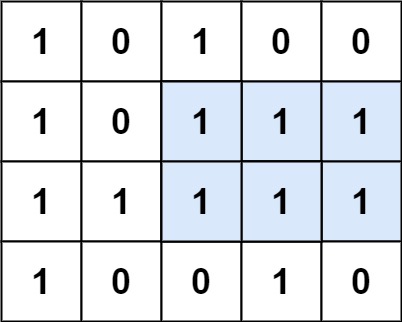
Input: matrix =
[["1","0","1","0","0"],["1","0","1","1","1"],["1","1","1","1","1"],["1","0","0","1","0"]]
Output: 6
Explanation: The maximal rectangle is shown in the above picture.
Example 2:
Input: matrix = [["0"]]
Output: 0
Example 3:
Input: matrix = [["1"]]
Output: 1
Constraints:
rows == matrix.lengthcols == matrix[i].length1 <= row, cols <= 200matrix[i][j]is'0'or'1'.
Solution Link to heading
In essence, this problem is akin to a layer encapsulating 84. Largest Rectangle in Histogram (Hard). Once this point is realized, the problem becomes less challenging.
Code Link to heading
class Solution {
  public:
    int largestRectangleArea(vector<int> &heights) {
        if (heights.size() == 1) {
            return heights[0];
        }
        stack<int> stk;
        int n = heights.size();
        int res = 0;
        for (int i = 0; i < n; ++i) {
            while (!stk.empty() && heights[i] < heights[stk.top()]) {
                int h = heights[stk.top()];
                stk.pop();
                if (!stk.empty()) {
                    res = max(res, (i - stk.top() - 1) * h);
                } else {
                    res = max(res, (i)*h);
                }
            }
            stk.push(i);
        }
        int right = stk.top();
        while (!stk.empty()) {
            int h = heights[stk.top()];
            stk.pop();
            if (!stk.empty()) {
                res = max(res, (right - stk.top()) * h);
            } else {
                res = max(res, h * n);
            }
        }
        return res;
    }
};